Article

OpenClaw: what it is, how to install it and connect Telegram

OpenClaw is a free, open-source AI assistant under the MIT license. It runs on your computer or server and answers in the messengers you already use: Telegram, WhatsApp, Discord, Slack, Signal and others. Installation is one terminal command, then a setup wizard connects the model, which takes about five minutes according to the docs. The software is free, while the model, the server, updates and security stay with the owner.

Updated October 28, 2026·8 min read
Neko plugs a cable into a small home server in the evening, wires run from it to colourful chat bubbles, a robot cat sits on the server holding a padlock, and a red toy lobster stands nearby

What OpenClaw is

OpenClaw is an open-source AI assistant that lives on your own hardware and meets you in the chats you already use. The project is developed by the OpenClaw Foundation, an independent non-profit, and the code is open under the MIT license. Its earlier names were Clawdbot and Moltbot, so older guides use them.

The core of OpenClaw is the gateway: a program on the server that takes messages from messengers, passes them to the model and sends the answers back. The connected model does the thinking, and OpenClaw gives it tools, memory and channels. How such agents work is covered in How AI agents work.

  • Messengers

    Telegram, WhatsApp, Discord, Slack, Signal, iMessage, Microsoft Teams, Matrix, Google Chat and others via plugins.

  • Skills and ClawHub

    A skill is a ready procedure the agent loads for a task. Plugins and skills are installed from the ClawHub catalog.

  • Schedule

    Scheduled jobs, hooks and webhooks: the agent works even without your message.

  • Several agents

    Separate agents with their own sessions and workspaces, for example for different people or tasks.

  • Any model

    Log in through Claude Code or Codex on the same server, or use a provider API key.

What you need to install it

  • A computer or server on macOS, Linux or Windows. For Windows there is the Windows Hub app, a PowerShell installer and a WSL2 option. For the agent to answer around the clock, it goes on a server that never switches off; why a laptop is a poor fit for this is covered in Local AI agent.
  • Node.js 24.22.1 or later, or 26.12.1 or later. The docs recommend Node 26.
  • Model access: a Claude Code or Codex login on the same computer, or a provider API key.
  • A terminal. Installation, the gateway, channels and updates are all done with commands.
  • A Telegram bot or an account in another messenger to talk to the agent.
  • Time for upkeep: updates, access, backups.

How to install OpenClaw: five steps

  1. Installation. On macOS and Linux run curl -fsSL https://openclaw.ai/install.sh | bash; on Windows run iwr -useb https://openclaw.ai/install.ps1 | iex in PowerShell. To try it without installing, use npx openclaw@latest.
  2. Setup wizard. The installer starts it for you. Quick start finds a Claude Code or Codex login or an API key, checks it with a real request, saves the config and opens the web dashboard. Custom setup walks through every option, and openclaw onboard --classic opens the classic step-by-step wizard.
  3. Running in the background. After the wizard the gateway runs in the terminal window. openclaw gateway install turns it into a service: a systemd user unit on Linux, a LaunchAgent on macOS and a scheduled task on Windows. openclaw gateway status shows its state; the gateway listens on port 18789.
  4. First conversation. openclaw dashboard opens the control panel in your browser, which has a chat. Check that the agent answers and remembers the previous message.
  5. Checks. openclaw doctor shows the problems it finds, and openclaw security audit checks whether your security settings have drifted from the safe defaults.

The full guide is in the OpenClaw documentation. The commands above were taken from it in October 2026. The project ships versions often, so check it before you install.

How to connect OpenClaw to Telegram

The docs call Telegram the fastest channel to set up: all it needs is a bot token.

  1. Open a chat with @BotFather, check that the handle is spelled exactly like that, send /newbot and save the token.
  2. Add the token to OpenClaw: openclaw channels add --channel telegram --token <token>.
  3. Start the gateway and check the channel: openclaw channels status --probe.
  4. Send the bot any message. By default it answers a stranger with a pairing code and passes your message to the agent only after approval. See the code with openclaw pairing list telegram and approve it: openclaw pairing approve telegram <code>. The code is valid for one hour.
  5. In a group the bot answers only when mentioned by default. For it to see every message, turn off privacy mode with /setprivacy at @BotFather or make the bot a group admin.

Keep the bot token secret: if it leaks, revoke it with /revoke at @BotFather and put the new one into OpenClaw.

OpenClaw and a Claude subscription

There are three ways to connect Claude to OpenClaw.

  • An Anthropic API key billed per token. The OpenClaw docs recommend it for shared automation and predictable spend.
  • A login through Claude Code installed on the same server. OpenClaw runs it as a program and does not store or refresh your login.
  • A long-lived token from the claude setup-token command.

Anthropic's subscription rules changed several times in 2026. On April 4 the company stopped counting subscription limits for third-party harnesses, and OpenClaw was cut off first. On May 13 Anthropic announced it would bring them back through a separate monthly credit, but on June 15 it paused that plan. As of October 28, 2026, the Anthropic help article, updated on June 15 and October 7, says that third-party apps, claude -p and the Claude Agent SDK draw from your subscription limits when you sign in with your Claude plan.

The OpenClaw docs warn that Anthropic can change Claude Code billing and limits without a new OpenClaw release. Before you set it up, check what the help article says now.

Security: what to know

OpenClaw ships with conservative defaults. The gateway listens only on the machine itself, strangers in direct messages get a pairing code, and groups use an allow list and answer on mention. The exception is ready-made container images: there the gateway is exposed to the network by default, so a password or token is required.

  • Do not expose gateway port 18789 to the internet. The docs advise reaching the dashboard through an SSH tunnel or Tailscale Serve.
  • One gateway is for one owner or a team whose members trust each other. For people with different levels of trust, set up separate gateways and keys, ideally under different system users or on different servers.
  • The agent reads other people's text: emails, pages, messages. They can contain instructions that try to steer the agent. Keep tool and file permissions narrow until you are sure everything works as intended.
  • Vulnerabilities are found and fixed. For example, in versions from 2026.3.22 up to 2026.6.6 a WhatsApp group ID could satisfy the elevated sender allow list. The project published this in advisory GHSA-fh38-965w-f6c3 and fixed it in version 2026.6.6. The defence against such bugs is updating on time.
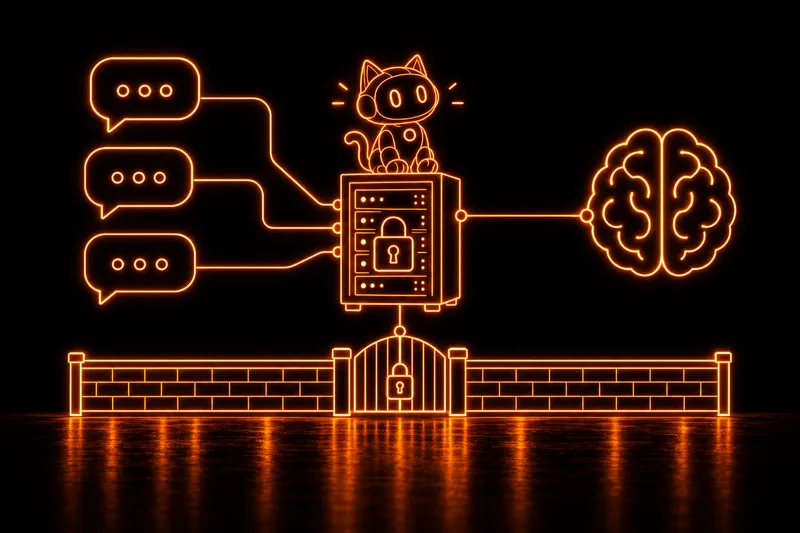
A robot cat sits on a server with a padlock; on the left, lines run to the server from three chat bubbles, on the right from the model's brain, and below the server is fenced off by a wall with a locked gate
The gateway on your server links messengers to the model, and there is no access to it from outside.

What you will maintain yourself

The OpenClaw docs say plainly that when you host it yourself, updates, network exposure, backups and access are on the owner. In practice that is five jobs.

  • Updates. openclaw update installs a new version and verifies it. Releases are frequent: from October 15 to 27, 2026 alone, five versions of the main line came out, the latest being 2026.10.8. For those who value stability there is the extended-stable channel.
  • Compatibility. Updates can break things: release 2026.8.1 of August 31, 2026 removed a built-in plugin, and third-party plugins had to be rewritten. Installs older than July 2026 are updated in two steps, via version 2026.9.5. After an update, run openclaw doctor --fix.
  • Backups. The docs advise keeping the agent's workspace in a private git repository and backing up the state regularly. A failed update rolls back the software, but database changes are not rolled back, so make a backup before a major update.
  • Access. The bot token, model keys, allow lists. If a key leaks, you replace it yourself.
  • Server and costs. Restarts after failures, disk space, closed ports. Scheduled checks run full agent turns, so frequent checks use more tokens.

This is manageable if you already administer a server. If not, set aside time: the first weeks go into getting the agent to run reliably.

Who OpenClaw suits

  • You are confident in the terminal and want an agent in all your messengers

    OpenClaw on your own server
  • You want to see how an open-source agent works in an evening

    OpenClaw on your computer via npx
  • You need an everyday assistant and have no time to fix it

    A turnkey agent
OpenClaw DIYNekoAgent turnkey
SoftwareFree, MIT licenseInstallation from 24,900 RUB once, for three installs
InstallationA terminal command and a setup wizardButtons in a bot; the first one with a curator on a call, about two hours
ModelClaude Code, Codex or a provider API keyClaude Code or Codex on your Claude or ChatGPT subscription
MessengersTelegram, WhatsApp, Discord, Slack and othersTelegram, text and voice
ServerYours, you set it upYour VPS, about 1,500 RUB a month
Updates and repairsYouRepairs: the Iris service; updates: you, with one button
BackupsYou set them upNightly encrypted backups

OpenClaw is a strong open-source project with a large community, and the difference between the paths is the same as with other open-source agents: who installs, fixes and updates it. A similar project is covered in Hermes Agent, and types of agents are compared in Which AI agent is best. In NekoAgent we do the first install together on a call with a curator, and then during paid support Iris monitors the agent around the clock and helps bring it back after failures (reasonable efforts, no guaranteed response time), makes nightly encrypted backups and ships tested updates you install with one button.

An agent without the terminal

Plans from 24,900 RUB for three installs. The first one is on a call with a curator, with training.

Key questions

What is OpenClaw?

A free, open-source AI assistant. It runs on your computer or server, connects to the model you choose and answers in Telegram, WhatsApp, Discord, Slack and other messengers.

Is OpenClaw free?

The software is free, MIT license. You will pay for the model, a subscription or an API key, and for a server if the agent must run around the clock.

How do I install OpenClaw?

On macOS and Linux with curl -fsSL https://openclaw.ai/install.sh | bash, on Windows with the PowerShell command from the project page. The installer starts the setup wizard, and openclaw gateway install keeps the gateway running in the background.

Does OpenClaw work with a Claude subscription?

According to the Anthropic help center as of October 28, 2026, third-party apps draw from your subscription limits when you sign in with your Claude plan. The rules changed in the spring, so check the Anthropic help center before you set it up. The other option is an API key billed per token.

How do I connect OpenClaw to Telegram?

Create a bot at @BotFather, add the token with openclaw channels add --channel telegram --token <token>, message the bot and approve the pairing code with openclaw pairing approve telegram <code>.

OpenClaw is a project of the OpenClaw Foundation, and Claude is a trademark of Anthropic. NekoAgent is not affiliated with them.


More articles

Neko assembles an AI agent from parts: a model, a server, Telegram and a knowledge base
Article · 8 min

How to create your own AI agent: DIY or turnkey

Your own AI agent needs four things: a model, a harness that gives the model memory and tools, a server where the agent runs around the clock, and a channel to talk to it, usually Telegram. You can put this together in a no-code builder, by hand from open source, or turnkey. Here is what each path costs in money and time.

Read the article
  • What an agent is made of
  • Three paths compared
  • Monthly cost
  • Turnkey, step by step
Neko weighs free software on a scale against a server, a model and time
Article · 6 min

Free AI agents: what is really free and what you pay for

The only free part of an AI agent is the software: OpenClaw and Hermes Agent are open source. The server that keeps the agent running around the clock and the model that does its thinking always cost money, and you pay for installation and upkeep with your time. The free tier of ChatGPT or Claude gives you a chat assistant, and you cannot build an agent out of it.

Read the article
  • What is free and what is not
  • Free ChatGPT vs an agent
  • OpenClaw and Hermes
  • Monthly costs
Neko examines a transparent robot cat through a magnifying glass; inside are the model, tools, memory and schedule
Article · 6 min

How AI agents work: explained in plain words

An AI agent is a language model that has been given tools, memory and a schedule. The model decides what to do, and a harness program carries out its decisions: reads files, sends messages, runs commands on a server. The agent works in a loop: it gets a task, makes a plan, takes a step, checks the result and decides what comes next.

Read the article
  • What an agent is made of
  • The work loop
  • How an agent remembers
  • Where agents go wrong
Neko at a desk between two robots: the assistant holds a speech bubble, the robot cat agent heads off to work with letters, an alarm clock and a key
Article · 6 min

AI agent vs AI assistant: the difference and which to choose

An AI assistant answers questions in a chat: you ask, it writes an answer, and you do the rest. An AI agent does the whole job: it works with email and files, remembers people and agreements, acts on a schedule and messages you first. The same model does the thinking for both; what differs is what is built around it.

Read the article
  • What the difference is
  • A comparison table
  • One task, two approaches
  • What to choose
Neko on a balcony records a voice message, and the robot cat agent writes her words into a glowing notebook
Article · 7 min

How to set up an AI agent: the first two weeks

Setting up an AI agent means telling it about yourself and your work, giving it simple first tasks and correcting it in words when it gets something wrong. All of this happens in an ordinary Telegram chat, without code. The agent writes what you say into memory, so every week it asks less and does better. Below is a plan for the first two weeks.

Read the article
  • What to tell it on day one
  • First tasks
  • How to correct the agent
  • Scheduled tasks
Neko in a bright workshop compares four robot agents on a table, a robot cat among them
Article · 7 min

Which AI agent is best: types of agents and how to choose yours

There is no single best AI agent for every case: agents come in four types, and each suits its own owner. They are cloud builders, the open-source agents OpenClaw and Hermes, your own agents on Claude Code or Codex, and ready-made turnkey agents. You choose by five questions: where the data lives, who fixes it, what it costs per month, whether it works in Telegram and which AI subscription it accepts.

Read the article
  • Four types of agents
  • Five questions to choose by
  • A comparison table
  • What to ask before buying
Neko in a bright office hands a stack of tasks to a robot cat sitting at its own desk with a laptop and a badge
Article · 7 min

AI employee: what it does, where a human is needed and what it costs

An AI employee is an AI agent given part of your regular work: correspondence, reminders, documents, summaries and reports. It works around the clock on a server, remembers people and agreements and runs tasks on a schedule. Money, promises to clients in your name and decisions with a high cost of error stay with a human. Per month an AI employee costs a server of about 1,500 RUB, an AI subscription and support.

Read the article
  • What the agent covers
  • Where a human is needed
  • Monthly cost
  • How to set tasks
In the evening Neko closes her laptop, while a robot cat with a phone sits on a running home server and keeps working
Article · 7 min

Local AI agent: on your own computer or on a server

A local AI agent is one that runs on your hardware rather than at a service. People mean two different things by it: a local model, when the neural network itself runs on your computer, and a local harness, when the agent program, files and memory live with you while a cloud model such as Claude or GPT does the thinking. An agent that works around the clock needs a computer that stays on, so it usually goes on your own server (VPS), about 1,500 RUB a month, rather than a laptop.

Read the article
  • Local model vs harness
  • An agent on a PC
  • Why you need a server
  • Where data is stored
In a small coffee shop Neko takes one sticky note with a task off a board and hands it to a robot cat holding a stopwatch
Article · 7 min

Implementing AI agents in a small business: a one-month plan and how to measure the gain

You can implement an AI agent in a small business within a month and without a separate project. Take one repeating routine, install the agent, spend two weeks fine-tuning it in ordinary chat and count how many hours a week it takes off your plate. No spec or integrations are needed at the start: an agent in Telegram only needs your explanations and access to the right files. Each month it costs a server of about 1,500 RUB and an AI subscription.

Read the article
  • The first routine
  • Two weeks of fine-tuning
  • How to measure the gain
  • Implementation mistakes
Neko types commands in a terminal in the evening, while a robot cat next to her studies an unfolded manual over an open box of parts, puzzled
Article · 7 min

Hermes Agent: what it is, how to install it and what you maintain yourself

Hermes Agent is a free, open-source AI agent from Nous Research under the MIT license. You install it on your computer or server, connect a model and a messenger, and it carries out tasks, keeps memory of past conversations and creates skills from solved tasks on its own. Installation is one terminal command or the Hermes Desktop app for Windows and macOS, followed by the “hermes setup” command. The software is free, while the model, the server and the upkeep stay with the owner.

Read the article
  • What Hermes can do
  • Installation step by step
  • Which models fit
  • What you maintain yourself
Neko works in AdsPower in the evening: the monitor shows a list of browser profiles, and the robot cat next to her points a paw at one of the rows
Article · 8 min

AdsPower: what this browser is and how to set up a profile and proxy

AdsPower is an antidetect browser: every profile has its own cookies, browser fingerprint and proxy, and websites see the profiles as different devices. That lets you run client accounts, team access and test accounts on one computer without mixing them up. AdsPower runs on Windows, macOS and Linux, two profiles are free forever, and you bring your own proxies: HTTP, HTTPS, SOCKS5 or SSH.

Read the article
  • What AdsPower is
  • A profile in five steps
  • Which proxies to pick
  • Common mistakes
Neko on a sofa in the evening with her phone compares two helpers on the table: a plain grey bot waits with a single message bubble, while a robot cat juggles a calendar, an email, a document and a reminder
Article · 7 min

AI bot for Telegram or an AI agent: the difference and which to choose

An AI bot for Telegram is a bot that passes your message to a neural network and sends its answer back to the chat. An AI agent in Telegram looks the same but works differently: it lives on a server, remembers people and tasks, works with your files and email and messages you on a schedule. To ask, translate or draft a text, a bot is enough. To run your affairs every day, you need an agent.

Read the article
  • What an AI bot in Telegram is
  • How an agent differs from a bot
  • Comparison and prices
  • When a bot is enough
Neko at a workbench in the evening compares two glowing cores, orange and teal, while a robot cat with an open chest hatch waits next to her for one of them
Article · 7 min

Claude Code or Codex: which engine to choose for a personal AI agent

Claude Code by Anthropic and Codex by OpenAI are two harnesses that turn a model into an agent: they give it files, commands and tools on a server. For a personal agent the main choice between them is the subscription: Claude Code runs on a Claude Pro or Max plan, Codex on a ChatGPT plan, in a server terminal from Plus and up. The agent's memory, Telegram and schedule do not depend on the engine, and in NekoAgent you can switch the engine later right from the chat.

Read the article
  • What Claude Code and Codex are
  • Which subscription you need
  • How they differ day to day
  • Can you switch engines
Neko in a bright loft writes an instruction card and hands a finished glowing card to a robot cat holding an open card file with colored tabs
Article · 7 min

Claude Code skills: how to teach an AI agent a new task

A Claude Code skill is a folder with a SKILL.md file: a short description of when it is needed and step-by-step instructions. The agent sees the descriptions of all its skills and opens the right one by itself when a task matches the description, reading the full text only at that moment. This way you teach the agent a recurring task once, such as replying to a review or a weekly report, and never explain it again. Codex by OpenAI understands the same format.

Read the article
  • What a skill is
  • How the agent picks a skill
  • Business examples
  • Skills and plugins
Neko relaxes in an armchair with a tablet while a robot cat sorts letters into trays on its own and shows her a card with a question mark and a green check; a low glass barrier glows next to the desk
Article · 7 min

Autonomous AI agents: what an agent does on its own and when it asks a human

An autonomous AI agent performs tasks without a command for every step: on a schedule and by the rules you gave it. It sends summaries and reminders, prepares drafts, records decisions in its memory and messages you first. Money, messages to people on your behalf and deleting data are best kept subject to your confirmation, even for an autonomous agent. Limits are set in two ways: with rules in your chat with the agent and with the access you give it.

Read the article
  • What the agent does alone
  • When it asks a human
  • How to set limits
  • Several agents
Neko in her kitchen in the evening looks at a chat message on her phone; a robot cat on the counter holds a glowing card with a bell and a checklist; on the fridge are a calendar with circled dates, a child's drawing and a shopping list, next to a grocery bag and a folder of documents
Article · 7 min

Personal AI assistant: errands, family and reminders in one chat

A personal AI assistant is an agent that runs your errands in Telegram: it remembers agreements, dates and documents, reminds you about them on its own and takes tasks by text or voice. It differs from an AI chat on your phone in two ways: it has a lasting memory about you and it messages you first when a deadline approaches.

Read the article
  • What to give the assistant
  • How it differs from a chat
  • An assistant for the family
  • Personal data